
Electric driving increases car use mainly outside peak hours

Electric cars are cleaner and cheaper to run than combustion-engine cars. They therefore make an important contribution to climate and air-quality goals. The question is whether these benefits also change travel behaviour. Research by the Netherlands Bureau for Economic Policy Analysis and the Netherlands Environmental Assessment Agency shows that this happens only to a limited extent. Switching to electric driving is actually accompanied by increased car use.
The research uses microdata on Dutch households, comparing travel behaviour before and after the purchase of an electric car. Following households over time makes it possible to link changes in mileage and journey types to the switch to electric driving. The study examined differences by travel time, purpose and journey type, including commuting, leisure trips and weekend travel. This approach allows researchers to describe the level of car use and analyse where and when changes occur.
Households that buy an electric car travel more kilometres by car after the switch than before. This increase is mainly explained by lower running costs and the perception that car journeys are less harmful to the environment. The threshold for choosing the car therefore becomes lower.
More kilometres, but outside peak hours
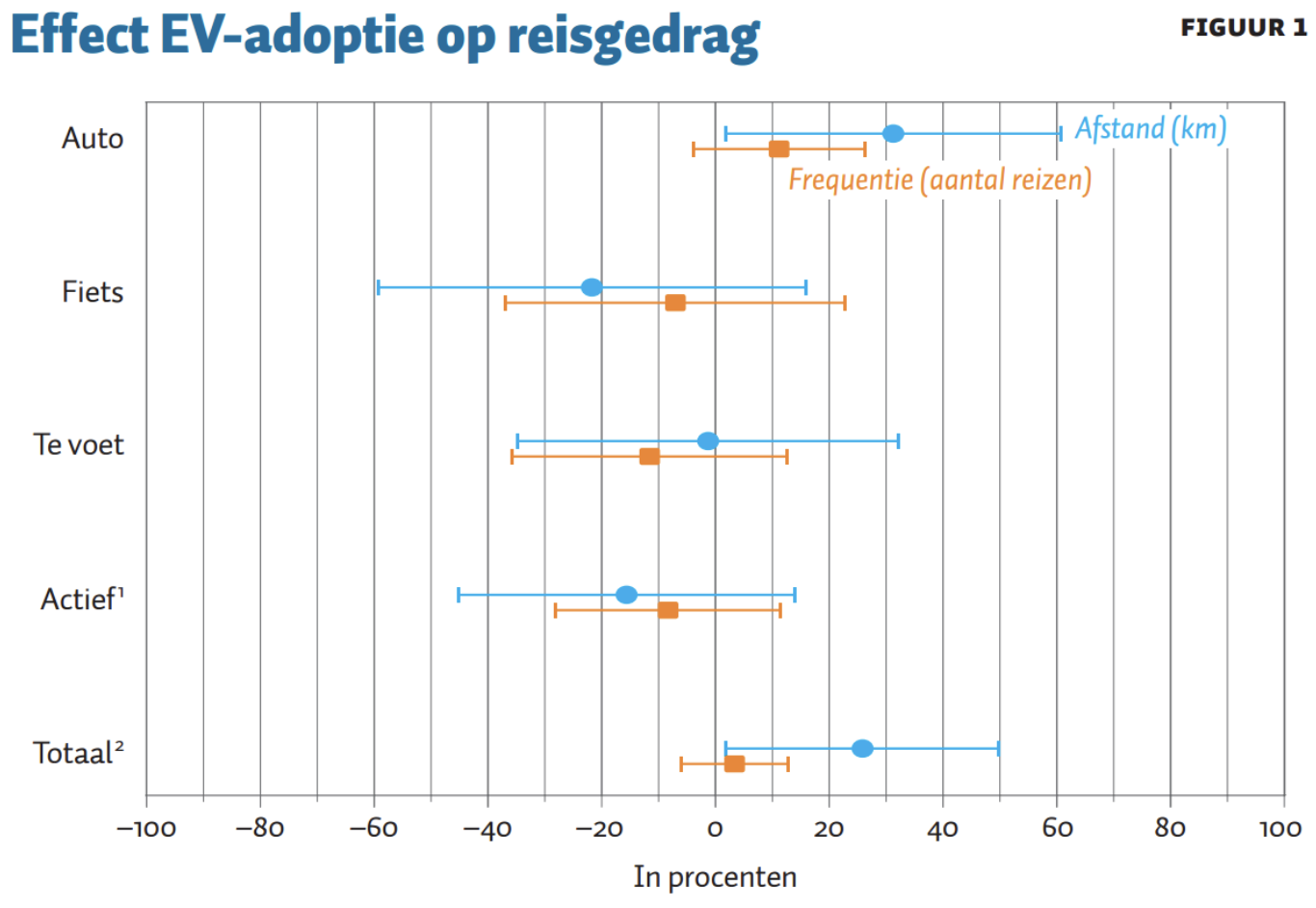
The additional mileage is not concentrated in commuting or regular rush hours. Growth occurs mainly outside peak hours and at weekends. It primarily involves longer journeys, for example for leisure or visits, rather than more short trips. The additional traffic pressure is therefore less evident at times when the network is already heavily loaded.
The study finds no evidence that electric driving replaces trips by bicycle or on foot. The share of active mobility remains broadly unchanged after switching to an electric car. Public transport use also shows no structural change.
Figure: Effect of EV adoption on travel behaviour, broken down by mode. The figure shows that increased car use mainly concerns distance travelled, while changes in cycling and walking are limited.
Social costs change very little
Although electric driving reduces CO₂ and air-pollutant emissions, other social costs of car use remain. Like conventional cars, electric cars contribute to congestion, road-safety risks and infrastructure wear. These effects are related to mileage and where and when vehicles are driven, rather than to their powertrain.
The analysis makes clear that electrifying the vehicle fleet does not solve these wider mobility challenges. As long as car use increases, the associated social costs remain.
Policy implications
The findings show that encouraging electric driving alone is insufficient to reduce car use. Those seeking to limit the social costs of mobility will need to consider additional measures. The research mentions price incentives reflecting the time and location of use, alongside investment in cycling and public transport infrastructure.
Electric driving delivers environmental benefits but does not fundamentally change travel behaviour. Without additional policy, cars, including electric ones, will continue to dominate everyday mobility.
Source: Netherlands Environmental Assessment Agency
All articles