Car sharing in the Netherlands in 2023: a growing opportunity
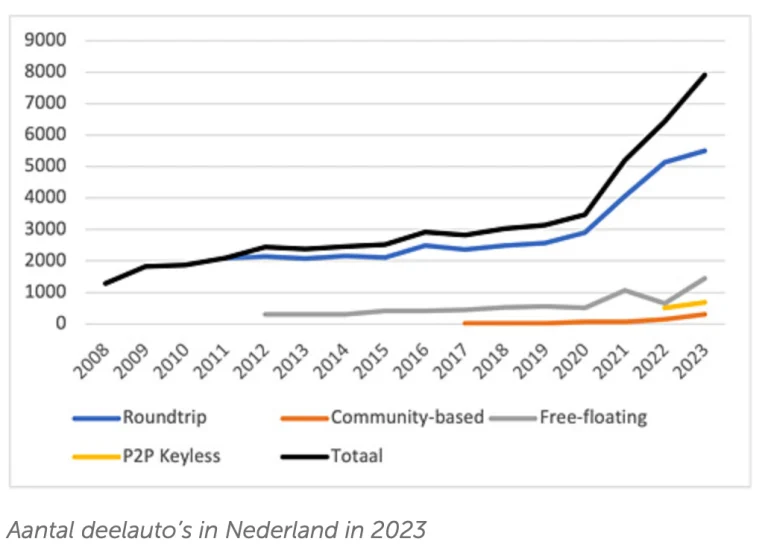
Car sharing in the Netherlands grew substantially in 2023. According to the annual CROW-KpVV survey, the number of shared cars rose by no less than 23%, from 6,442 in 2022 to 7,920 vehicles this year.
The different forms of car sharing
Car sharing offers a range of mobility options, allowing people to book and use locally available cars on their own terms, however long they need them. This form of shared mobility contributes to various policy objectives, including reducing CO2 emissions, easing parking pressure in urban areas and making public space more inclusive.
CROW-KpVV distinguishes four categories of shared cars in the Netherlands: roundtrip, where the user returns the car to its collection point; free-floating, where the car can be left anywhere within the service area; community-based, where a fixed group of users shares one or more cars; and keyless peer-to-peer, where privately owned cars are shared through a platform without a physical handover of keys.
From a niche to the early majority
Although car sharing remains a niche market, it is growing steadily. The 2022 National Travel Survey showed an increase from 4% to 7% within a single year. The percentage is even higher in major cities such as Utrecht and Amsterdam. Growth in car sharing is not confined to the Netherlands; this form of shared mobility has also gained ground in neighbouring countries such as Germany.
Electrification as a defining feature
Notably, almost half (48%) of the shared cars surveyed in 2023 were electric, a substantial increase on 2022 (37.9%). This growth in electrification far exceeds the trend across the Dutch vehicle fleet as a whole, where electric vehicles account for 7.1%.
Regional differences and innovation
At provincial level, the Randstad provinces lead the way, but the number of shared cars is also growing steadily elsewhere, including Groningen and Noord-Brabant. At municipal level, car-sharing initiatives are flourishing in both highly urbanised and moderately urbanised places, such as Culemborg and Bunnik.
The future of car sharing
Growth in car sharing is being driven by innovative technologies both inside and outside the vehicle. These make it easier to use a shared car or offer one for others to use. Vehicle-sharing apps increase flexibility in mobility choices and save time.
Contributing to sustainability
Awareness of climate challenges plays an important role in the growth of car sharing. More people are considering the societal impact of products and services when making decisions. Car sharing contributes to sustainability and more conscious mobility choices, resulting in 20% fewer car kilometres and ultimately at least 30% fewer cars.
Charging infrastructure and low-traffic city centres
As electric shared transport grows, so does the need for charging facilities. The Netherlands is investing in an extensive charging network, with more than 1.7 million electric cars anticipated by 2025. The development of low-traffic city centres also helps people embrace car sharing, as parking facilities for shared cars are often more accessible than those for private cars.
Conclusion
The impressive growth of car sharing in the Netherlands points to a shift in mobility preferences. This development offers opportunities for sustainable urban planning and a greener future. Source: CROW
All articles