Autonomous driving in the Netherlands
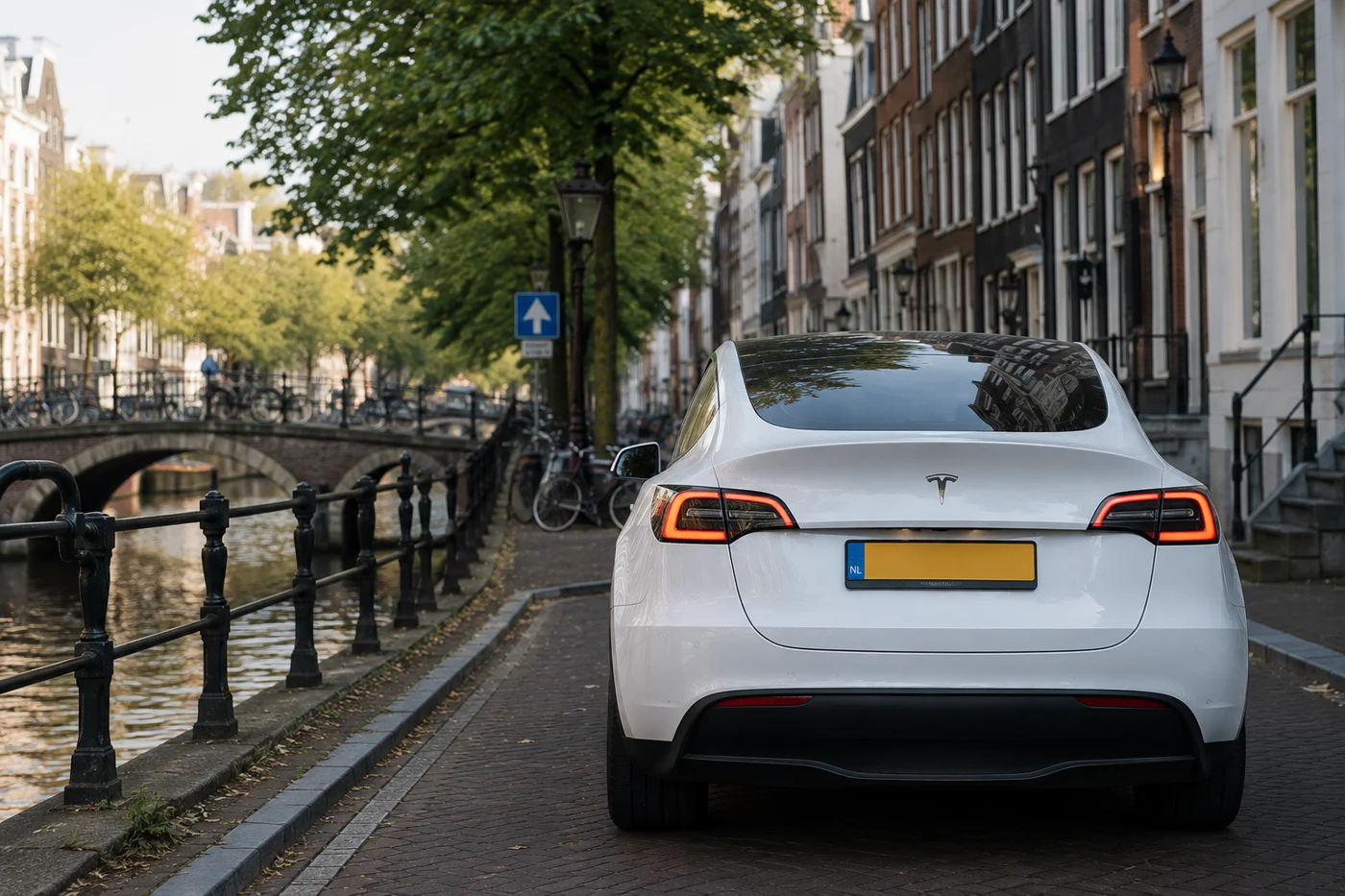
On Thursday 27 August 2026, MyWheels is taking another step in the application of automated driving. The provider will gradually integrate Tesla's Full Self-Driving (FSD) into its shared car fleet. The first car will enter service in Den Bosch, and MyWheels aims to introduce at least fifty shared cars with FSD before the end of 2026.
The launch also featured on RTL Nieuws that morning. The significance was not so much that automated driving functions are new to the Netherlands, but that MyWheels is making the technology available on a larger scale within a shared fleet that ordinary users can book.
For us, this is a good opportunity to consider the development more broadly. As automated and, potentially, fully autonomous driving functions continue to evolve, their impact will eventually extend beyond shared cars. The same technology could become part of private cars, company fleets, taxis and other mobility services.
In time, this development could affect not only how we drive, but also how we park, organise mobility, manage traffic flows and design developments.
FSD still requires supervision
This is not yet fully autonomous driving. Tesla itself calls it Full Self-Driving (Supervised). Drivers must remain attentive, retain responsibility for driving and be able to intervene at any time.
Margriet van Schijndel, a mobility expert at Eindhoven University of Technology, also made this distinction on RTL Nieuws. She highlighted the scale at which the technology is now becoming available to ordinary users. At the same time, she stressed the importance of continued driver attention. Precisely when a system takes over many tasks, there is a risk that this attention will decline on longer journeys.
According to Van Schijndel, the technology will continue to develop, both within the vehicle itself and in communication with infrastructure and road authorities. Automated driving is expected eventually to offer road safety benefits too. However, she says there is not yet evidence that the current generation of vehicles actually drives more safely than a human.
Beyond shared cars
For the longer term, MyWheels envisages a situation in which a user orders a shared car through an app, the vehicle drives to them on its own and then leaves for the next user after the journey.
This could have major implications for shared mobility. The Netherlands Institute for Transport Policy Analysis studied how much Dutch passenger cars are actually used. Around half the cars studied are stationary for more than 96.3% of the time. Even the most intensively used car in the study was parked for more than 90% of the time.
A shared autonomous vehicle could potentially be used much more intensively. After a journey, it would not have to wait for the same user for a long period, but could drive to its next trip, a charging location or a storage facility. In theory, a smaller fleet could then meet a greater demand for mobility.
But the development extends beyond shared mobility. When the same technology becomes commonplace in private cars, a different dynamic emerges. A car would no longer necessarily have to remain at its owner's destination. It could drop someone off and then drive independently to another parking location, return home or move to somewhere that parking is cheaper or easier.
The need for parking would not necessarily disappear, but it could move elsewhere.
The changing spatial role of parking
For area development, the question would therefore be not only how many parking spaces are needed, but also where they are provided, how long vehicles stay there and what purpose a parking location serves.
An autonomous shared vehicle could be used again immediately after a journey. For a privately owned autonomous car, the parking location could be further from the destination, because the user would no longer have to cover that distance themselves.
This could affect where parking facilities are located within a development. A space directly beneath or beside every destination might become less of a given, while central facilities or mobility hubs could play a greater role.
The purpose of such a hub could also change. It might become more than a place where vehicles are parked for long periods: an operational centre where vehicles wait, charge, receive maintenance and are redistributed across an area.
Part of the design challenge would then shift from organising stationary vehicles to organising mobility flows.
Less parking does not automatically mean less traffic
This is precisely where traffic engineering comes into focus. An autonomous shared car travelling to its next user after a journey makes another vehicle movement. So does a private car that drops someone off and then drives independently to a parking location. Some of these future journeys could therefore take place without a passenger.
Less parking pressure at a destination does not automatically mean less traffic. It may even mean that a vehicle makes several journeys on the road network for a single person's trip.
The number of vehicles is therefore not the only factor: how far they travel, at what times, along which routes and with how many occupants also matters.
This makes the way a future system is organised at least as important as the technology itself. The location of parking and charging facilities, the management of shared fleets, limiting empty mileage and connections with cycling and public transport all ultimately affect traffic volumes.
The design of places also changes
When vehicles can collect and drop off users independently, new questions about space also arise.
Where will people be collected and dropped off? How much space is needed at entrances? Where can vehicles wait temporarily? Where will they charge? How will these movements fit into traffic circulation? And how can we prevent convenience for motorists from coming at the expense of pedestrians, cyclists, traffic flow or the quality of public space?
Many development projects currently focus heavily on the parking solution: how many spaces are needed, where will they be provided and how will they be accessed?
As automation advances, this approach becomes broader. Parking, picking up and dropping off, charging, traffic circulation and connections with other modes of transport become increasingly interconnected.
This also calls for a different approach to public space. Space that may no longer be needed for long-stay parking does not automatically have to remain allocated to cars. It could also be used for greenery, walking, cycling, places to spend time or other purposes. The outcome will vary from place to place.
Different implications for cities and regions
Space is scarce in urban areas. If vehicles no longer need to remain at their destination for as long, or a smaller shared fleet can meet the same mobility demand, parking areas in certain locations could be freed up for other uses.
On the other hand, more pick-ups, drop-offs and empty vehicle movements could place additional pressure on streets and access roads. Space saved on parking may therefore create a new traffic challenge.
Outside the major cities, the challenge is different. Distances are greater and public transport does not offer a viable alternative to the car everywhere.
MyWheels identifies a possible future application in precisely these areas. If a vehicle can drive to a user independently, shared mobility could become available in areas where there are too few users for a conventional car-sharing system. The RTL Nieuws broadcast also mentioned a possible connection with regional public transport.
This development therefore concerns not only parking or car sharing, but wider accessibility issues too. These include how villages, amenities and public transport interchanges might be connected in the future.
Exactly how this develops will depend on factors including cost, regulation, technological development, user acceptance and connections with existing transport networks.
Looking ahead without banking on future benefits
Fully autonomous driving is not yet a given for today's development projects. It would therefore be premature to translate possible future benefits directly into lower parking requirements or permanently fewer parking spaces.
At the same time, the places and infrastructure we design today are built to last for decades.
Flexibility therefore becomes more important. A parking facility that is essential today may serve a different purpose in a future mobility system. A mobility hub could evolve from a place primarily for storing vehicles into a place for parking, charging, sharing and managing mobility flows.
Traffic planning also requires a forward-looking approach. Changes within one development can affect traffic flows beyond it. At a broader scale, it becomes increasingly relevant to consider how parking locations, hubs, access routes and different modes of transport function together within a neighbourhood, city or region.
The introduction of FSD into the MyWheels fleet will not transform the Dutch mobility system overnight. The technological, legal and societal uncertainties are still too great.
It is, however, a concrete development that highlights the questions likely to become more pressing in the years ahead. These concern not only how many parking spaces are needed, but also where vehicles are located, how they are used, which traffic movements they generate and how much space different forms of mobility are allocated in our cities and other areas.
Parking, mobility and traffic are thus becoming ever more closely connected as parts of the same spatial challenge.
All articles