
Shared scooters and environmental impact
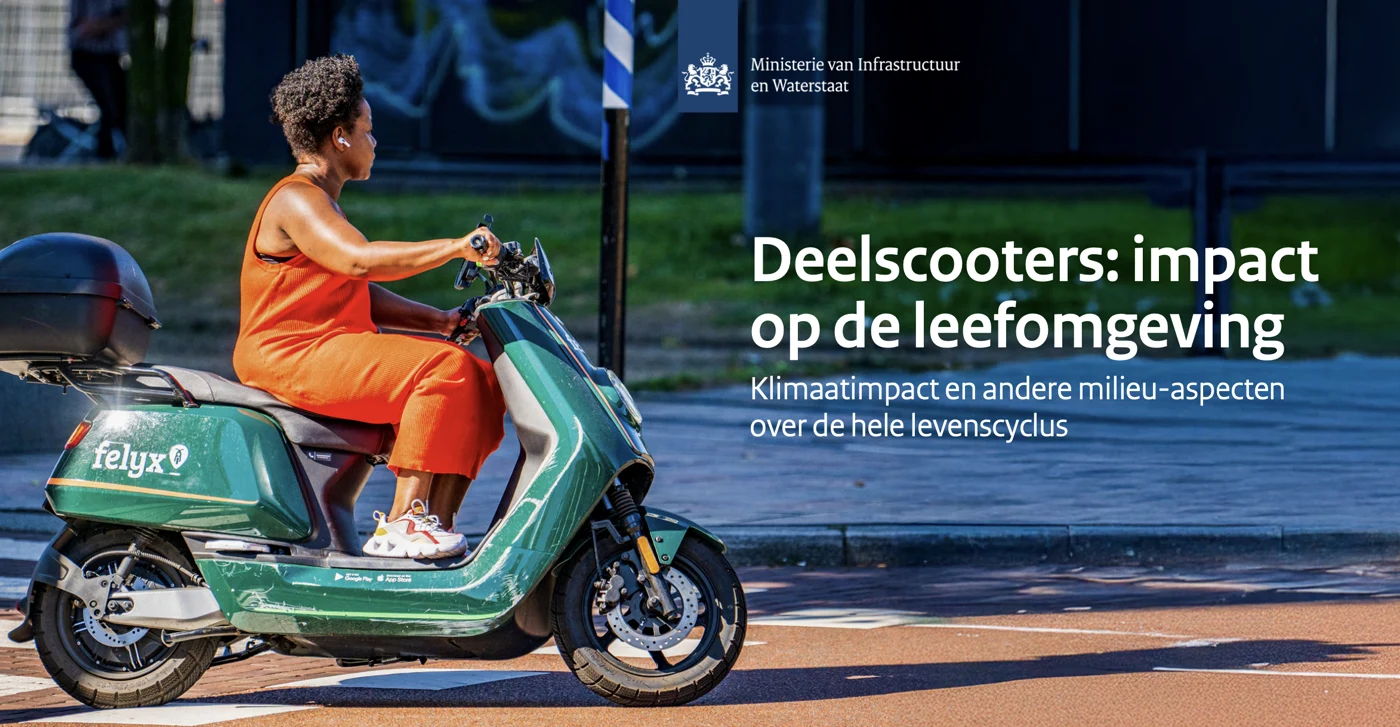
On 29 April 2025, the Netherlands Institute for Transport Policy Analysis (KiM) published the report Shared scooters: impact on the living environment. It analyses the environmental impact of shared electric scooters across their full life cycle, from production and use to disposal. The study offers policy-relevant insights into greenhouse-gas emissions, particulate matter, toxicity and the role of shared scooters in the wider mobility system.
Climate impact across the full life cycle
Shared electric scooters generate an average of 29 grams of CO₂ equivalents per passenger-kilometre when powered by renewable electricity. Using the Dutch electricity mix, this rises to 36 grams CO₂-eq/passenger-km. Shared scooters therefore perform better than petrol mopeds, at around 63 g CO₂-eq/passenger-km, and both combustion-engine and electric cars.
The main sources of emissions are scooter and battery production, battery charging and operational services such as battery swaps and maintenance. Direct urban emissions are minimal, resulting in cleaner air in densely populated areas.
Lifespan, occupancy and distance travelled are key factors in the total impact per kilometre. Shared scooters generally have larger batteries and shorter lifespans than privately owned electric scooters, resulting in slightly higher emissions per kilometre than private use.
Particulate matter and toxic substances
Shared scooters also affect the environment through particulate matter formation and emissions of toxic substances. These mainly arise during battery and component production, often outside the Netherlands. Unlike petrol mopeds, which mainly cause local air pollution, electric scooters shift environmental harm to the supply chain before use.
Life-cycle assessments show a lower impact on particulate matter formation than petrol mopeds. Results for human toxicity vary depending on methods and assumptions. Contributions to acidification and other environmental effects are relatively limited.
Comparison with other modes of transport
Shared scooters perform better than cars, diesel buses and petrol mopeds in terms of greenhouse-gas emissions per passenger-kilometre. Their emissions are higher than those of bicycles, e-bikes, metros and electric shared or public transport bicycles. This is mainly because these modes are much more efficient per kilometre and require less operational support.
For other environmental indicators, such as toxicity and particulate matter formation, shared scooters also fall between motorised and active transport. Metros and bicycles remain the modes with the lowest impact.
The effect of replacing other modes
A key finding of the report is that the environmental benefit of shared scooters depends heavily on which mode they replace. Replacing a journey by a combustion-engine car or moped offers substantial benefits: up to 80% fewer greenhouse-gas emissions compared with a combustion-engine car.
If the journey replaces walking, cycling or using an e-bike, however, the overall environmental impact increases. User research shows that the alternative to a shared-scooter journey varies significantly between cities. In Rotterdam, an estimated 23% of shared-scooter journeys would otherwise have been made by car.
The role in multimodal journeys
Shared scooters can be useful as part of a multimodal journey, for example combined with a train trip. Their flexibility makes them suitable for the first or last leg of longer journeys. In this context, they can replace short car trips or journeys in combustion-engine taxis.
Availability is nevertheless limited to urban areas, and use is restricted to service zones. This makes them a promising addition to public transport, but not a universally applicable one. There remains a risk that shared scooters will be used for journeys where a bicycle or public transport bicycle would be more environmentally friendly.
Policy options and limitations
According to KiM, public authorities, operators and users can help lower environmental impact by deploying shared scooters thoughtfully. Authorities can encourage use where it replaces car journeys, while discouraging it in areas where active mobility makes more sense.
Operators can reduce environmental impact by keeping scooters in service longer, expanding service areas and increasing the average distance travelled. Users can contribute by choosing shared scooters primarily as an alternative to driving.
Scooter and battery production largely takes place outside the Netherlands. Dutch policymakers therefore have limited influence over part of the environmental burden. European regulation could help guide developments over time, for example in battery production and recycling.
Relevance to development projects and mobility plans
Shared scooters have the potential to support cleaner mobility, provided their use genuinely reduces car mileage. Where they replace cycling or walking, the environmental burden increases instead.
KiM's message is clear: shared scooters can complement the mobility system, but they require careful choices about deployment, location and policy.
The KiM findings make clear that shared mobility needs a tailored approach. Shared scooters only deliver environmental benefits if they reduce car use and connect effectively with multimodal travel. For development projects and mobility plans, this means that use at each location must guide decisions.
Monitoring which modes are replaced, making logical connections with public transport interchanges and protecting active mobility are essential to achieving sustainable results.
📄 Read the full KiM report here: Shared scooters: impact on the living environment
All articles