
An accessible parking space linked to two number plates
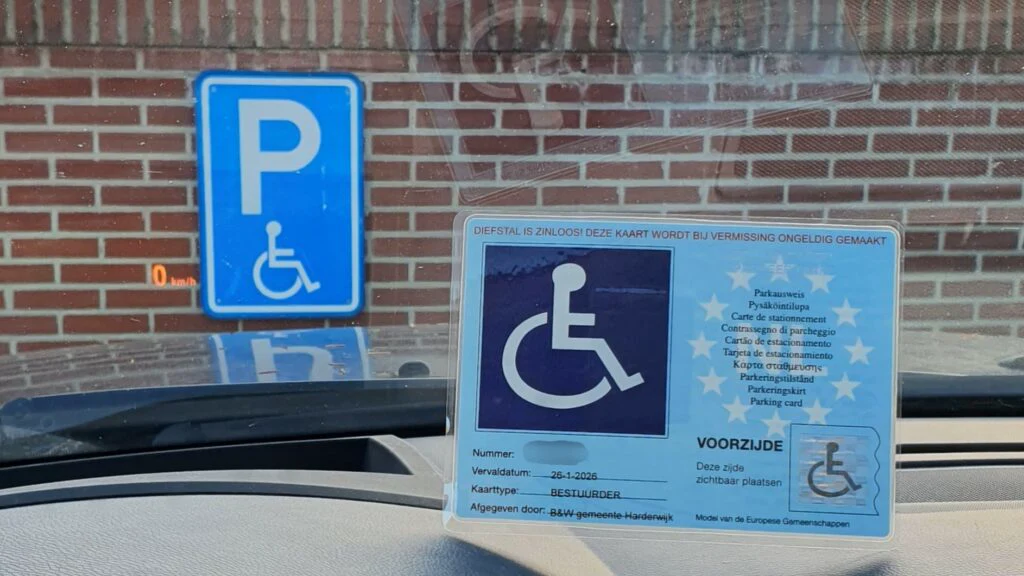
On 29 September 2025, the Gelderland District Court ruled that one accessible parking space may be linked to two number plates, provided this is carefully justified and clearly indicated on the supplementary sign.
The ruling clarifies an issue that is becoming increasingly common in practice. Accessible parking plays an important role in the design of parking and mobility solutions, particularly in areas where space is limited and parking pressure is high.
Background to the case
Two residents separately applied for an accessible parking space near their homes.
The municipal executive decided to designate one space for both number plates. Parking pressure in the neighbourhood did not allow separate spaces for both applicants, and one of them also had a usable parking option on private land.
The residents objected and appealed. They argued that assigning several number plates to one accessible parking space was not permitted under Article 26 of the Dutch Traffic Rules and Traffic Signs Regulations 1990 (RVV 1990).
The court's ruling
The court rejected this argument.
According to the court, Article 26 RVV 1990 allows a parking space to be assigned to a specific person or category of vehicles. The provision does not require the designation to be limited to one number plate.
The crucial requirements are that the restriction, in this case the link to two number plates, is clearly shown on the supplementary sign and that the decision is properly justified.
The court found that the municipal executive had rightly considered:
- The high parking pressure in the neighbourhood,
- The availability of parking on private land,
- The interests of both applicants.
Because this balancing of interests was clear and could be followed, the court accepted the decision to allocate one space to two vehicles.
Policy discretion and justification
The ruling shows that there may be flexibility in providing accessible parking, as long as decisions are made carefully and transparently.
Clear justification remains essential:
- The grounds for linking the number plates,
- How parking pressure and the spatial context were considered,
- Why the solution is considered reasonable in relation to the applicants' interests.
Implications for design and public space
In practice, accessible parking is more than a legal or policy issue: it also affects the design of public space.
An area's design usually accounts for the required number of parking spaces and the relevant accessible-parking requirements. At the same time, the aim is to avoid providing more parking than necessary, as this takes space away from greenery, play areas and the quality of public space.
If further requests for accessible spaces arise after completion, for example because of an ageing population, they can noticeably affect available space and the distribution of parking capacity.
The ruling shows that this can be addressed carefully without compromising accessibility or usable public space.
Read the full ruling here: link
The header photograph was taken by Ralph Stoové, RaGaSto.nl
All articles